Alabama Fence Laws and Property Lines Explained
What you’ll learn
- Alabama has no single fence code. State partition law, city zoning, HOA covenants and your plat all apply, and the strictest one wins.
- A fence on the shared line between improved lots is a joint expense under Ala. Code 35-7-3.
- A fence sitting on your land for 10 to 20 years can support an adverse possession claim, so fix it early.
- Huntsville requires no permit for residential fences, but height limits, sight triangles and historic district rules still apply.
- Call Alabama 811 at least 2 full working days before digging post holes.
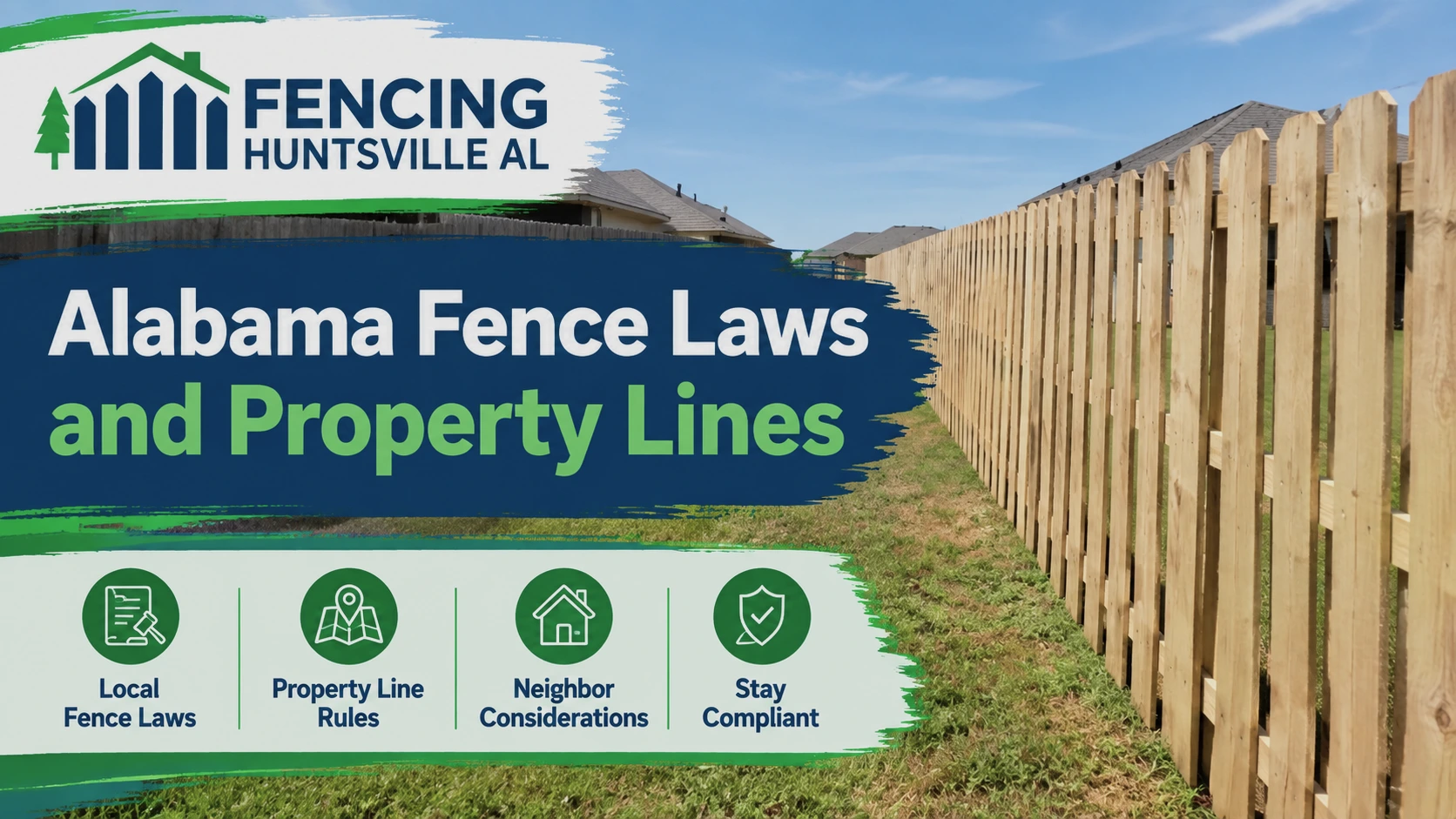
Alabama has no single statewide fence code. Your fence answers to four rulebooks at once: state partition fence law (Ala. Code Title 35, Chapter 7), your city or county zoning ordinance, your HOA covenants, and the property line on your recorded plat. In Huntsville, residential fences need no building permit, but height, placement, and shared-cost rules still apply.
Which Alabama laws control a fence on a property line
Four layers of rules decide where your fence goes and who pays for it. The strictest one wins. A fence can be legal under state law, legal under city zoning, and still get you a violation letter from your HOA.
| Rule layer | What it controls | Who enforces it |
|---|---|---|
| State partition fence law (Ala. Code § 35-7-1 and following) | Cost sharing for fences on the line between improved lands | District court, through appointed fence viewers |
| City or county zoning | Height, front yard limits, corner lot sight triangles, banned materials | City of Huntsville, City of Madison, or Madison County |
| HOA covenants | Style, color, material, and approval before install | Your HOA or architectural review committee |
| Deed, plat, and survey | Where your land actually ends | Civil court if neighbors disagree |
Most fence fights in North Alabama start in the bottom row. Somebody guessed where the line was. Somebody else paid a surveyor. Guess who usually wins.
The state pillar on permits covers the city-by-city paperwork in detail. Start with our North Alabama fence permit guide if your first question is whether you need approval at all.
Not sure where your line sits? We walk the property and check your plat before we quote anything.
Does my neighbor have to pay half of a shared fence in Alabama
Often, yes. Alabama Code § 35-7-3 says partition fences between improved lands are built and repaired at the joint expense of the occupants. If your neighbor later ties into your fence or uses it as their own enclosure, the law says they owe you their share, based on the fence's condition at the time they start using it (Code of Alabama § 35-7-3, Justia, 2024).
Three details matter before you send your neighbor an invoice.
- The statute covers fences on the dividing line between improved lands, so a fence set two feet inside your own lot is your fence and your bill.
- If you can't agree on the split, either owner can apply to the district court in the county where the fence sits, and the court appoints fence viewers to decide each share.
- The filing fees written into the statute are tiny, fifty cents for the court order and one dollar per viewer, split between you (Ala. Code Title 35, Chapter 7, OneCLE).
Yes, those fee amounts were set generations ago, and nobody updated them. It is the cheapest legal proceeding you will ever hear about. Your attorney's hourly rate is another story.
Short answer: In Alabama, a fence built on the shared line between two improved lots is a joint expense by law. A fence built entirely on your side belongs to you, and your neighbor owes nothing for it unless they start using it as part of their own enclosure.
My neighbor wants to attach his fence to mine without paying
This is the classic Huntsville backyard standoff. You built a privacy fence along the back and one side. Two years later the new neighbor fences his yard and ties his runs into your corner posts. Section 35-7-3 was written for exactly that move. If your fence sits on the line, he is using it as a partition fence, and he owes you a proportional share of its value at the time he joined it.
If your fence sits a few feet inside your lot, it gets simpler. He can't attach to it without your permission, because it's on your land.
What happens if my neighbor's fence is on my property in Alabama
A fence on your land does not transfer ownership overnight, but time works against you. Under Alabama's adverse possession statute, Ala. Code § 6-5-200, a neighbor can claim land after 10 years of possession with color of title, tax listing, or descent cast, and Alabama courts also apply a 20-year rule for open, exclusive, hostile possession without those elements (Ala. Code § 6-5-200, Justia).
Translation: a fence that sits two feet over the line for a decade can quietly become a legal argument. The fix is cheap now and expensive later.
- Pull your recorded plat from the Madison County Probate Office or the Limestone County equivalent, and read the lot dimensions.
- Hire a licensed Alabama land surveyor to locate or reset your survey pins, the iron rods buried at each lot corner.
- Share the survey with your neighbor in writing, calmly, with a photo of the flagged pins.
- Offer options, like moving the fence, a written boundary line agreement, or a recorded permission letter that blocks a hostile possession claim.
- Talk to a real estate attorney only if the first four steps fail.
A written permission letter matters more than people think. Adverse possession needs hostile use. If you gave written permission, the use isn't hostile, and the clock doesn't run the same way. Ask your attorney to draft it so the wording holds up.
Can I tear down a fence my neighbor built on my side of the line
Don't. Even if the survey proves you right, self-help removal can hand your neighbor a property damage claim and turn a fixable disagreement into a lawsuit. Get the survey, put your request in writing, and let an attorney or the court order the removal if it comes to that.
How close to the property line can I build a fence in Huntsville
The City of Huntsville does not require a building permit for a residential fence, per the city's residential construction FAQ (City of Huntsville, Residential Construction FAQ). There is no citywide minimum setback for fences the way there is for sheds, which must sit 5 feet from side and rear lines. Most homeowners build 6 to 12 inches inside the line anyway.
That small buffer does three jobs for you.
- It keeps the whole fence, footings included, on your land, so no one can argue it's a shared partition fence you both own.
- It lets you paint, stain, and repair the outside face without stepping on your neighbor's grass.
- It protects you if your survey pin was off by a few inches, which happens more than surveyors like to admit.
The trade-off is the strip of yard outside the fence. You still own it and still mow it. Some folks call it "the neighbor's free lawn." We call it the cost of never going to court.
What Huntsville zoning still says about fence height and placement
No permit does not mean no rules. Summaries of the Huntsville zoning ordinance put front yard fences at a 4-foot maximum and side and rear fences at 6 feet, ban barbed wire, razor wire, and electric fence on residential lots, and restrict anything between 2.5 and 15 feet tall inside the corner lot sight triangle (PermitsGuide, 2026). Confirm your lot's zoning district in the Huntsville zoning ordinance on Municode before you commit to a height.
Two other Huntsville exceptions catch people. Homes inside a local historic district, like Twickenham or Old Town, need Historic Preservation Commission approval before a fence goes up. And a fence inside a utility easement is allowed at your risk, meaning the utility can remove it for access and won't rebuild it.
| Situation in Huntsville city limits | What applies |
|---|---|
| Standard backyard privacy fence | No permit, 6-foot height cap per zoning summaries |
| Front yard fence | 4-foot height cap per zoning summaries |
| Corner lot | Sight triangle limits near the intersection |
| Historic district | Historic Preservation Commission approval required |
| Fence across a utility easement | Allowed, but the utility can remove it without replacing it |
| HOA neighborhood | HOA approval required on top of all of the above |
Madison and unincorporated Madison County run on different rulebooks. If your address says Madison, Harvest, or Hazel Green, read our breakdown of fence permits in Madison County and unincorporated areas before you order materials.
Why a survey beats the old fence line every time
The old fence line is the least reliable boundary marker on your property. Previous owners set fences where the ground was flat, where a tree wasn't, or where a brother-in-law with a string line thought it looked about right. None of that is a legal boundary.
Here's a call we get more often than you'd think. A family closes on a house in a newer Madison subdivision. The backyard has a sagging wood fence. They hire someone to replace it "in the same spot." Six months later the neighbor's survey shows the old fence, and now the new one, sits 18 inches onto the neighbor's lot. The fence is brand new. The line was wrong the whole time. The fix means pulling posts set in concrete and paying twice.
A survey, or at least locating the existing survey pins against your plat, turns that story into a non-event. On most subdivision lots the pins are still in the ground, a few inches under the sod.
Short answer. Never replace a fence "in the same spot" without confirming the property line first. Old fence lines in North Alabama are guesses as often as they are boundaries, and Alabama's partition and adverse possession rules both depend on where the true line sits.
Local proof from a recent Huntsville job
Last spring we quoted a 184-foot, 6-foot board on board cedar fence for a family in Hampton Cove. The old pine fence had stood for about 15 years, and the homeowner wanted the new one "right where the old one was."
Before we dug, we checked the recorded plat and found 3 of the 4 survey pins with a metal detector. The back run of the old fence sat 14 inches onto the neighbor's lot for about 70 feet. We set the new line 8 inches inside the true boundary instead.
The homeowner gave up a strip of grass about the size of a hallway runner. In exchange, the neighbor signed off in writing, there is no argument over who owns the fence, and nobody is paying to pull concrete-set posts two years from now.
Who has to put the good side of the fence facing out
Alabama has no statewide law that says the finished side of a fence must face your neighbor. Some local ordinances and a lot of HOA covenants do require the finished face toward the street or the adjoining lot. Check your HOA covenants first, since that is where this rule shows up most in Madison and Huntsville subdivisions.
If your HOA is silent, face the good side out anyway. It keeps the peace, it looks better from the street, and it takes the argument off the table. Board on board and shadowbox styles solve the problem for good because both faces look finished. Our privacy fence installation team can show you both options on site.
HOA rules add their own layer of approval, timelines, and submission paperwork. The full process lives in our guide to getting HOA fence approval in Madison.
Do I have to call 811 before I dig fence post holes in Alabama
Yes. Alabama law requires anyone excavating, homeowners included, to notify Alabama 811 at least 2 and no more than 10 full working days before digging, not counting the day you submit the request. The service is free, and you can file online or dial 811 (Alabama 811, 2026).
Once the paint and flags go down, hand dig inside the tolerance zone, which runs at least 18 inches on each side of a marked line. One more wrinkle the flags won't tell you: utilities mark water lines up to the meter, so the private line from the meter to your house is yours to find.
Post holes feel small. A power auger through a buried fiber line is not small. Neither is the bill.
What Alabama fence rules apply on rural land and acreage
Alabama is a fence-in state. Open range ended statewide under Ala. Code § 3-5-2, which means livestock owners must keep their animals contained and can be liable when those animals get loose and cause damage. If you run cattle or goats outside Huntsville city limits, in Toney, New Market, or Gurley, the fence is your legal responsibility, not your neighbor's.
The partition fence rules in Title 35 still apply to line fences between two improved rural tracts. On a long rural boundary, a written agreement on who maintains which half saves a lot of arguments during the first storm that drops a tree across the wire.
What to do before you build a fence on or near a property line
Five steps cover nearly every property line problem we see in the Tennessee Valley.
- Confirm the line with your plat and your survey pins, or order a new survey if the pins are missing.
- Check your city or county zoning for height limits, sight triangles, and historic district rules.
- Get written HOA approval before any post goes in the ground.
- Talk to the neighbor and put any cost-sharing or maintenance deal in writing.
- Submit an Alabama 811 locate request at least 2 full working days before digging.
Do those five and the law mostly becomes background noise. Skip them and it becomes the main event.
We handle the property line check, the HOA submission, and the 811 request as part of every residential fence project in North Alabama. If your fence is going up inside city limits, our Huntsville fence contractor page lists the neighborhoods and subdivisions we work in most.
We handle permits, HOA submissions, and the property line check for you. Call (256) 877-5278 or request a free on-site estimate below.
This article explains general Alabama fence law for homeowners. It is not legal advice. For a boundary dispute, talk to a licensed Alabama real estate attorney.
Frequently asked questions
Need a fence quote? Talk with our local team.