Wood or Vinyl Fence for Alabama Humidity
What you’ll learn
- Humid air alone does not rot wood. Liquid water sitting against the post, the bottom rail and the end grain does.
- Pressure treated wood runs $26 to $38 per linear foot installed in Huntsville and lasts 12 to 18 years.
- Vinyl runs $40 to $60 per linear foot and lasts 25 to 30 years with a rinse once or twice a year.
- Green streaks on vinyl are surface algae, not damage, and wash off with soap and a soft brush.
- Wood still wins on sloped lots, heavy tree cover, large acreage and any move inside eight years.
- Posts must be UC4A ground contact rated, set on gravel, with a two inch gap above the soil.
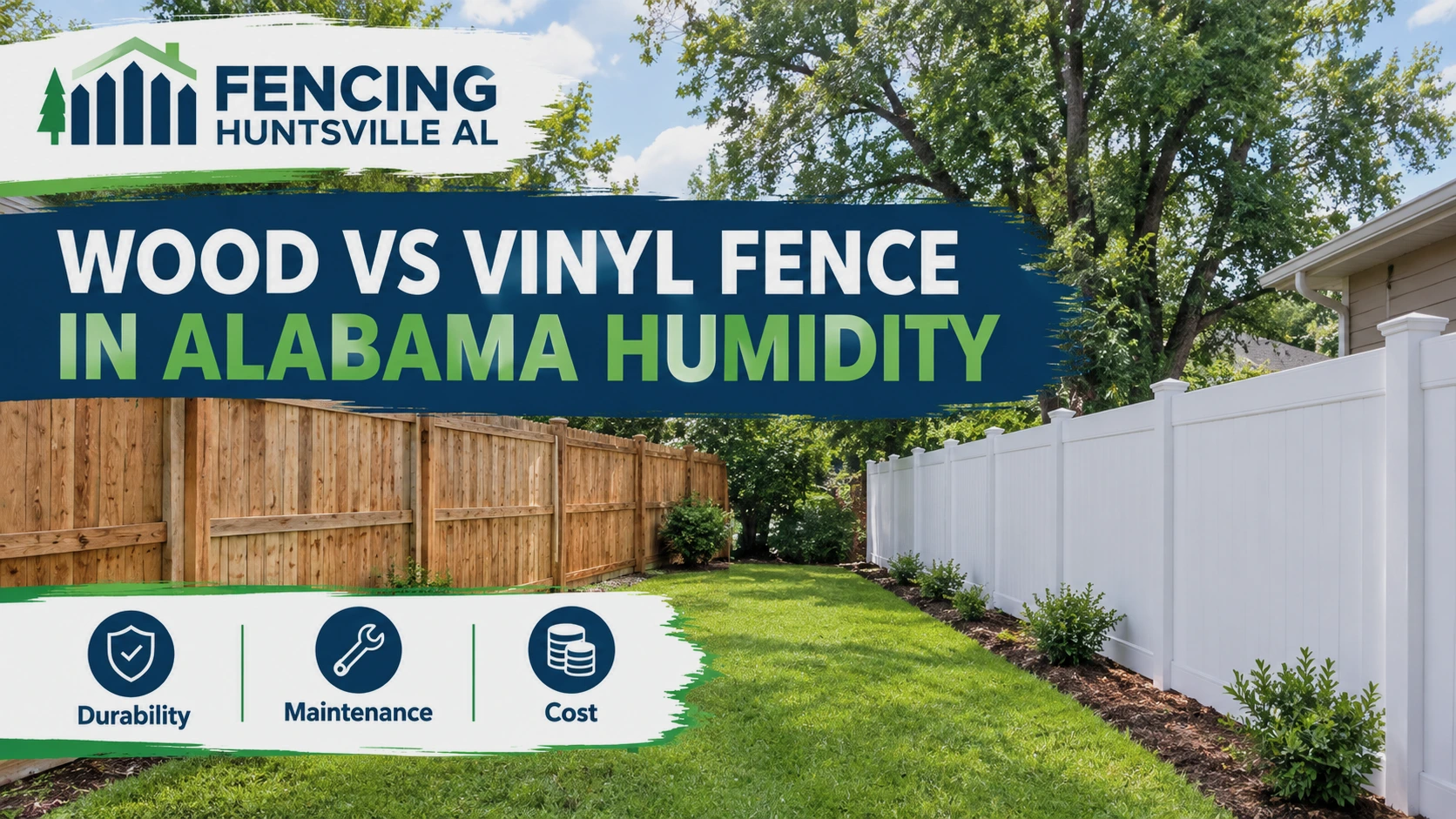
Which fence holds up better in Alabama humidity, wood or vinyl
Vinyl holds up better in humidity. Wood rots because it absorbs liquid water from soil, splash and trapped debris, and vinyl cannot rot at all. The catch is that humid air by itself does not rot a wood fence. Ground contact does. Spec the posts correctly and a wood fence in Huntsville lasts 12 to 18 years.
That distinction matters more than the material argument, and almost nobody makes it. A homeowner in Hampton Cove once told us his fence was "rotting from the humidity." We pulled a picket off. The boards four feet up were fine. The bottom rail, which sat an inch above wet mulch and never dried, came apart in a hand.
Humidity did not kill that fence. Standing water and poor drainage did. Here is what actually happens to each material in the Tennessee Valley, what each one costs to own over twenty years, and which one fits your yard.
What 54 inches of rain a year does to a wood fence
Huntsville gets a normal annual precipitation of 54.29 inches, and the National Weather Service notes that December through March alone account for about 43 percent of that total (NWS Huntsville, 2026). That is a long wet season with short drying windows, which is exactly the condition wood dislikes.
The science is narrower than most fence pages admit. The USDA Forest Products Laboratory states that water vapor in humid air alone will not wet wood enough to support significant decay, though it will let mold fungi develop, and that fully air dried wood at 20 percent moisture content or less has a reasonable margin of safety against fungal damage (USDA Forest Products Laboratory, 2021).
Read that again, because it rewrites the whole argument. Muggy August air makes your fence gray and speckled. It does not make it rot. Rot needs liquid water sitting against the wood long enough to push it past the fiber saturation point.
The four places liquid water finds a wood fence in North Alabama:
- The buried section of the post, where red clay holds water against the grain for days after a storm.
- The bottom rail and the last two inches of picket, where mulch, leaf litter and grass clippings pile up and stay damp.
- The end grain on every cut board, which drinks water roughly ten times faster than a face grain surface.
- Any spot a sprinkler head hits twice a week, which is a slow motion demolition crew nobody thinks to reposition.
Fix those four and a wood fence in Madison behaves like a wood fence in a dry climate. Ignore them and you get the leaning, punky bottom rail that sends people searching for fence repair in Huntsville around year eight.
One more local factor. Alabama sits in the heaviest termite pressure zone in the country, and termites want the same wet wood the fungi want. Dry wood is a poor meal and a poor home.
Want a real number for your yard instead of a range? We measure on site for free and tell you which material we would put on our own property.
How vinyl actually behaves in Huntsville heat and cold
Vinyl ignores moisture completely. PVC does not absorb water, so it cannot rot, swell, cup or feed termites. What vinyl does react to is temperature, and that is where installation quality decides whether you love it or fight it.
Rigid PVC fence profiles are governed by ASTM F964, which caps the coefficient of linear expansion and sets minimum impact resistance at both 73.4°F and 32°F (ASTM International, F964-13). Two practical consequences follow.
First, vinyl grows and shrinks with the seasons. A rail that spans eight feet moves a visible fraction of an inch between a January morning and a July afternoon. Good installers leave the rails floating in the post pockets so that movement has somewhere to go. Bad installers screw the rails tight and the panel bows by the second summer.
Second, PVC gets less impact resistant as it gets colder. The standard tests it at freezing for exactly that reason. In Huntsville that is a minor issue, since we get a handful of hard freezes a year, but it explains why a riding mower bumps a vinyl post harmlessly in June and cracks it in January.
Why vinyl fences get green streaks in North Alabama
Green or black streaking on vinyl is algae and mildew growing on the surface, not damage to the material. It shows up on the north facing side, in shade, and wherever a sprinkler or a downspout keeps the panel wet. The fence is not failing. It is just dirty.
A garden hose, a soft brush and a bucket of soapy water clear it in an afternoon. Skip the pressure washer on a high setting, which can dull the finish and force water into the post pockets. Compare that to a wood fence, where the same shady wet corner means stripping, cleaning and resealing.
The twenty year cost comparison most fence quotes leave out
Vinyl costs more on day one and less by year twenty. Pressure treated pine runs $26 to $38 per linear foot installed in the Huntsville market, and vinyl runs $40 to $60, per our Huntsville fence pricing guide. The gap looks brutal until you add the maintenance and the replacement date.
| Factor | Pressure treated wood | Vinyl (PVC) |
|---|---|---|
| Installed cost per linear foot | $26 to $38 | $40 to $60 |
| Realistic life in North Alabama | 12 to 18 years | 25 to 30 years |
| Upkeep cycle | Wash and seal every 2 to 3 years | Rinse once or twice a year |
| Reaction to humidity | Absorbs water, can rot at ground contact | Absorbs nothing, cannot rot |
| Reaction to heat and cold | Cups, splits and twists as it dries | Expands and contracts, brittle in hard freeze |
| Storm damage repair | Replace a picket for a few dollars | Replace a full panel or post |
| Termite risk | Real, managed by treatment and drainage | None |
Run a 150 foot backyard through that. Wood lands somewhere around $3,900 to $5,700 installed. Vinyl lands around $6,000 to $9,000. Then wood asks for a wash and seal seven or eight times across twenty years, and it asks for a replacement before year twenty is over. Vinyl is still standing and still asking for a hose.
The honest summary is this. If you plan to sell inside eight years, wood is the cheaper decision and the money you save is real. If this is the house you retire in, vinyl usually wins the twenty year math in this climate.
When wood is still the right call in North Alabama
Wood wins on four specific conditions, and we say so even though vinyl is the higher ticket sale. Price, repairability, appearance and terrain all point back toward wood in certain yards.
- Budget. Wood buys roughly forty percent more fence per dollar, which matters when you are enclosing a full acre in Harvest rather than a small yard in Providence.
- Sloped lots. Wood racks and steps easily along the grade lines that run through Monte Sano and Hampton Cove. Vinyl panels are rigid and need stepped sections, which look fine but cost more and leave triangular gaps at the bottom.
- Storm repairs. A limb through a wood fence costs a few boards. A limb through a vinyl fence costs a panel, sometimes a post, and a wait on a color match.
- Looks. Some people want cedar. No vinyl on the market convinces anyone up close, and a stained board on board fence is still the better looking product in a wooded lot.
If any of those describe your property, read the full North Alabama fence materials comparison before you commit, since aluminum and composite may fit better than either option here.
How to spec either material so humidity stops mattering
Both materials survive North Alabama when the ground work is right, and both fail when it is not. The failure point is almost always where the fence meets wet clay, not where it meets the sky.
If you choose wood, insist on these five things in writing:
- Posts rated UC4A ground contact, not the UC3B above ground lumber that sits next to it at the home center (American Wood Protection Association, 2025).
- Hot dipped galvanized or stainless hardware, because modern copper based treatments eat plain steel fasteners.
- A gravel base under each post so water drains away instead of pooling in the bottom of the hole.
- A two inch gap between the bottom of the pickets and the soil, kept clear of mulch and clippings.
- A wash and seal in the first year, then every two to three years after, per our seasonal fence maintenance schedule for Alabama.
If you choose vinyl, insist on these three:
- Profiles that meet ASTM F964, with the manufacturer named on the quote rather than a generic "premium vinyl" line item.
- Rails left free to move in the post pockets, and concrete footings sized for wind load on a solid privacy panel.
- Steel or aluminum inserts in the gate posts and any post carrying a hinge, since an unreinforced vinyl gate post sags within a season.
Before anyone digs, call Alabama 811 at least two working days ahead. That is a legal requirement in Alabama, not a courtesy, and it applies to you and to your contractor.
A quick decision box for Huntsville and Madison yards
| Your situation | The material we would install |
|---|---|
| HOA neighborhood in Madison, wants low upkeep, staying long term | Vinyl |
| Half acre or more to enclose, budget is the constraint | Pressure treated wood |
| Steep or rolling lot with a lot of grade change | Wood, racked to follow the slope |
| Wet back corner that never dries out | Vinyl, with drainage corrected first |
| Selling within five to eight years | Wood |
| Heavy tree cover and frequent limb drop | Wood, for cheap repairs |
Check your covenants before you fall in love with either one. Several Madison subdivisions restrict material and color, and our guide to HOA fence approval in Madison AL covers what the architectural committee will want to see. Huntsville city limits do not require a fence permit for a standard residential fence, though historic districts do, which our North Alabama fence permit guide walks through.
What to do next
Walk your fence line after the next hard rain and find where the water stands. That spot decides your material more than any price sheet does. If it drains within a day, wood is on the table. If it stays wet, put vinyl there or fix the grade first.
We install both across Huntsville, Madison, Harvest and the rest of the Tennessee Valley. Look at our wood fence installation and vinyl fence options, or see what we build for homeowners in Madison and Huntsville. If you want full screening either way, our privacy fence builds start from the same site walk.
Send us the footage and a photo of the wet corner. We will tell you which material we would put on our own house, even when it is the cheaper one.
Frequently asked questions
Need a fence quote? Talk with our local team.