Fence Maintenance by Alabama Season
What you’ll learn
- Never apply stain or sealer between December and March. That stretch carries about 43 percent of Huntsville's annual rain, and wood moisture is at its yearly high.
- Late winter is for inspection only. Push every post at the top, tighten fasteners, and clear vegetation before spring storm season.
- May through September is the staining window. Wash mildew off first, let the wood dry, then brush the finish on.
- September through November is the best gate and hardware window, because wood adjusted during dry weather still closes once winter swelling starts.
- Semitransparent stain lasts 2 to 4 years on new smooth wood and 4 to 8 years once the boards have weathered. Paint lasts longest on siding and performs worst on a fence.
- Termite swarms in Alabama follow rain by one to three warm, calm days, so check posts for mud tubes after spring storms.
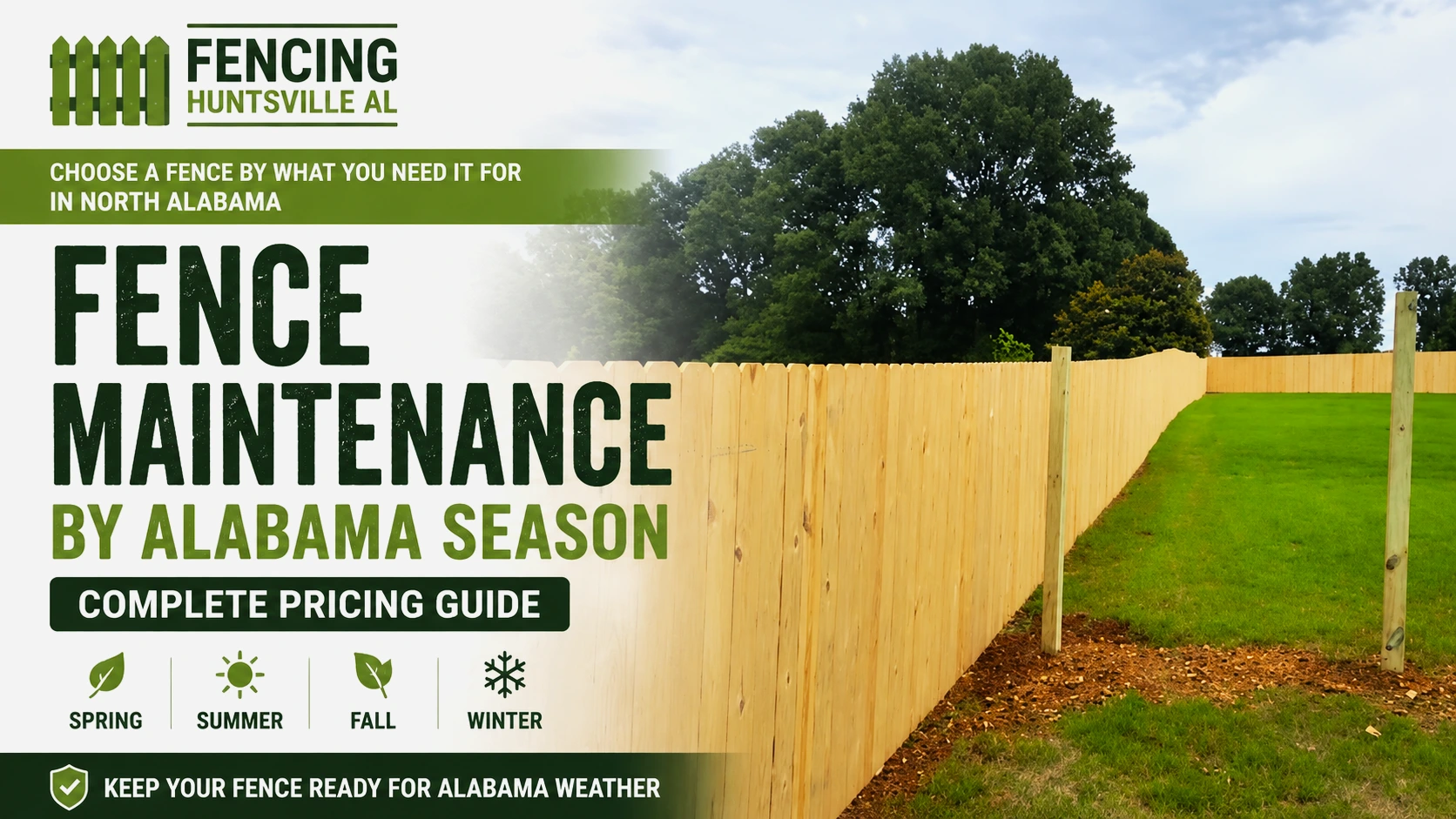
Fence maintenance in Alabama runs on a four-part calendar. You inspect and clear in late winter, wash and stain between May and September, tune gates and hardware in fall, and keep every finish off the wood during the wet stretch from December through March. Follow that order and a wood fence lasts. Ignore it, and you buy a replacement years early.
What North Alabama weather actually does to a fence
Four forces do almost all the damage here, and they take turns. Water swells and shrinks the boards. Sun breaks down the surface fibers. Red clay lifts and drops the posts. Termites treat a ground-contact post like a buffet. Every task later in this guide exists to slow one of those four down.
The water part is the one people underestimate. The National Weather Service reports that December through March alone account for about 43 percent of Huntsville's normal annual precipitation (NWS Huntsville). Your fence spends a third of the year soaking, then dries out fast in July. That cycle is what splits boards and pops fasteners.
| Force | What it does to your fence | Worst months |
|---|---|---|
| Rain and humidity | Swells boards, feeds mildew, keeps post bases wet | December to March |
| UV exposure | Breaks down surface lignin, fades stain, grays the wood | June to September |
| Clay shrink and swell | Loosens footings, tilts posts, opens gate gaps | Spring wet, late summer dry |
| Wind | Racks panels, snaps rails, drops limbs on the line | March to June |
| Termites | Hollows ground contact posts from the inside | April to July |
Wind deserves a specific mention because North Alabama gets more of it than the rest of the state. The Alabama Office of the State Climatologist reports that Lauderdale and Madison counties log some of the highest average annual damaging wind activity in Alabama, and that damaging wind reports actually run higher in June than during the spring tornado peak, largely from summer microbursts (UAH Alabama Office of the State Climatologist, 2026). A fence in Madison takes more wind load than the same fence in Montgomery.
Want a straight answer on whether your fence is worth maintaining or worth replacing? We measure and inspect on site at no charge.
February through April, walk the line and get ahead of storm season
Late winter is inspection season, not finish season. The ground is still wet, temperatures swing, and any stain you apply now will disappoint you by August. Spend this window finding problems instead.
Walk the entire fence line and grab the top of every post. A post that moves more than an inch at the top has a footing problem, not a board problem. Note which ones move and how much, because that list decides your budget for the year.
- Push each post firmly at the top and mark any that rock, since loose posts get worse fast once spring storms arrive.
- Cut back vines, shrubs, and mulch piles that hold moisture against the boards, keeping at least a hand's width of air behind everything.
- Tighten or replace loose fasteners now, because a rail that has already worked loose is the first thing a June wind gust takes.
- Look for mud tubes running up posts and check for swarmers after warm rain, which is when Alabama termite colonies fly.
On termites, the Alabama Cooperative Extension System recommends an annual inspection for every homeowner in the state and notes that swarms follow rain events by one to three warm, calm days during spring and early summer (Alabama Cooperative Extension System, 2025). If you see winged insects around a fence post after an April storm, that is a call to a pest company, not a fence company.
Should I stain my fence in March in Alabama
No. The Forest Products Laboratory sets a hard floor of 50°F for latex finishes, held for a full 24 hours after application, and 40°F for oil alkyd products (USDA Forest Products Laboratory, Wood Handbook, 2010). A 68-degree March afternoon in Huntsville still drops to 41 overnight. The finish never cures properly, and you get to do the whole fence again next year.
May through August, wash first and then stain
Summer is when the actual finishing work happens. Warm boards, low overnight humidity compared with winter, and long dry windows between fronts. Wash the fence, let it dry, then stain it. In that order, with no shortcuts between them.
Mildew is the black blotchy growth you will find on the north-facing side. It does not rot the wood, but no finish bonds to it. The Forest Products Laboratory recommends washing it off with a commercial mildew cleaner or a dilute household bleach and detergent solution, then rinsing thoroughly before you refinish.
Two warnings that come straight from the lab and cost people real money every year. Never clean cedar, redwood, or oak with steel wool or a wire brush, because trace iron reacts with the tannins in those woods and leaves dark blue-black stains that get sealed under your new finish. And rags soaked with oil-based stain are a spontaneous combustion risk, so drop them in a sealed, water-filled metal container the moment you finish. Your fence looking good is not worth your garage.
My wood fence turned gray after two summers in Huntsville, did I get ripped off
Probably not. Gray is the normal result of UV breaking down the surface layer, and it starts within hours of exposure. The good news is that the damage is skin deep. Forest Products Laboratory erosion data shows unfinished exterior wood loses roughly a quarter inch of thickness per century, so a gray fence is a finish problem rather than a structural one. Wash it, let it dry, and stain it. It comes back.
September through November, the window most homeowners skip
Fall is the best time of year to work on a fence in North Alabama, and almost nobody uses it. The NWS notes that fall precipitation runs appreciably below the winter wet season here, which gives you longer dry windows than June ever does, with none of the August heat that makes stain flash off before it penetrates.
This is also gate season. Wood swells as the winter rain arrives, so a gate you adjust in October has room to move. A gate you adjust in January will bind again in July.
- Adjust hinges and latches before the wet season, since a gate set during dry weather still closes once the boards take on moisture.
- Clear leaves and soil that have piled against the bottom rail, because a fence buried two inches into wet mulch rots from the bottom up.
- Check that downspouts and gutter runoff discharge away from the fence line rather than into a post footing.
- Handle any post resets now while the clay is still workable, rather than fighting saturated ground in February.
If a gate has dropped so far that it drags, the hinge screws have usually pulled out of a post that is itself moving. Our gate repair crew in Huntsville resets the post rather than shimming the hinge, because shims buy you one season.
December through February, keep every finish off the wood
Winter is a hands-off period for anything involving a brush. The wettest stretch of the year is exactly when wood moisture content is highest, and a finish applied over wet wood peels, blisters, or traps the moisture underneath. The Forest Products Laboratory also warns against finishing late in the day when heavy dew is expected overnight, which describes most of a Tennessee Valley winter.
What you can do in winter is structural. Check posts after every storm system, especially any you flagged as loose back in February. Redirect water. Clear limbs off the top rail before the next round of wind arrives.
If a post has to come out and you are digging a new hole, contact Alabama 811 first. State law requires 2 to 10 full working days of notice, not counting the day you submit, and a locate ticket stays valid for 20 working days. Note that 811 members do not mark private lines, so your irrigation, invisible pet fence, septic, and propane lines are still your problem (Alabama 811). Slicing a sprinkler main with a post hole digger is a rite of passage nobody enjoys.
The one-page Alabama fence maintenance calendar
| Window | Do this | Do not do this |
|---|---|---|
| February to April | Full walk-through, post-push test, fastener tightening, vegetation clearing, termite swarm watch | Stain, paint, or seal anything |
| May to August | Wash mildew, let dry, apply stain or water repellent, check sprinkler spray patterns | Stain in direct afternoon sun on a hot surface |
| September to November | Adjust gates and hardware, reset posts, clear the base, fix drainage, second staining window | Leave leaf piles banked against the boards |
| December to February | Post storm inspections, water management, plan next year's work | Apply any finish, dig without an 811 ticket |
How often to stain a wood fence in Alabama
Every two to four years for a first coat on new smooth wood, and every four to eight years once the surface has weathered and holds more finish. Those are Forest Products Laboratory service life figures, not marketing numbers, and they assume vertical exposure with a proper brush application.
| Finish type | Look | Expected service life |
|---|---|---|
| Water repellent preservative | Natural tan, grain fully visible | 1 to 3 years |
| Lightly pigmented clear finish | Natural color, slight tint | 2 to 3 years |
| Semitransparent stain, one coat on new smooth wood | Grain visible, color as chosen | 2 to 4 years |
| Semitransparent stain on weathered or saw textured wood | Grain visible, deeper color | 4 to 8 years |
| Paint or solid color stain | Grain and color hidden | 10 to 20 years on siding, far less on a fence |
That last row is the trap. Paint lasts longest on a wall and performs worst on a fence. Film-forming finishes seal moisture inside the wood when the end grain is not sealed first, and the lab documents exactly that failure on fully exposed railings and fences. Use a penetrating finish on a fence and repeat it more often. It is less work than stripping peeling paint off 180 feet of pickets.
Four application details that decide whether you get the low end or the high end of those ranges.
- Brush the stain rather than spraying it, because brushing works the finish into the wood and prevents the lap marks that spray application leaves on a fence panel.
- Check the surface an hour after application, and wipe off anything still shiny, since a finish sitting on top of the wood forms a thin film that cracks within a year or two.
- Let new pressure-treated lumber dry before finishing, which the lab puts at roughly a week for copper-treated wood, longer if it arrived soaking wet from the yard.
- Plan roughly 200 to 400 square feet per gallon on smooth wood and 100 to 200 on saw-textured wood, and remember you are coating both faces.
One encouraging note. Your second application will outlast your first, because weathered boards absorb more finish than fresh mill smooth ones do. The worst staining day of your life is the first one.
What each fence material needs in this climate
Maintenance load varies by material more than by brand. If you are still choosing, our guide to fence materials for North Alabama covers the tradeoffs, and the weather performance breakdown for Tennessee Valley conditions covers how each one handles humidity and wind.
- Pressure treated pine needs the full seasonal cycle above, including a wash and a penetrating finish every two to four years, since it is the most moisture-sensitive common option here.
- Cedar resists decay better but still grays without a finish, and it is the one material where a wire brush will permanently stain the wood.
- Vinyl needs an annual wash and nothing else, though North Alabama red clay splash leaves rust colored staining along the bottom rail that plain water will not lift.
- Aluminum and ornamental steel need a hose down and a yearly look at the hinge and latch hardware, which fails long before the panels do.
- Chain link needs tension checks and attention to the bottom tension wire, plus rust watch at any spot where the galvanizing got scratched during installation.
How do I get red clay stains off a white vinyl fence
Clay staining on vinyl is mineral, not organic, so mildew cleaner does nothing for it. You need a mild abrasive or an oxalic acid-based cleaner and patience. Fix the cause at the same time by extending mulch beds or adding gravel at the fence base; otherwise, every hard rain repaints the bottom eighteen inches. Full method in our [LINK PENDING] guide to cleaning red clay stains off vinyl fencing.
Five maintenance mistakes that cost real money in Huntsville
- Pressure washing at close range. A 3,000 psi tip six inches from pressure-treated pine tears out the soft earlywood and leaves a fuzzy surface that soaks up water for the rest of the fence's life.
- Cleaning cedar with a wire brush. The iron reacts with cedar tannins and produces blue-black staining that your new stain seals in permanently.
- Painting a wood privacy fence. It looks sharp for four years, then peels at every board joint, and stripping it costs more than the original finish did.
- Aiming a sprinkler head at the fence. Daily irrigation keeps the bottom twelve inches of every picket permanently damp, which is the single fastest way to rot a fence in Madison County.
- Digging a post hole without an 811 ticket. Free service, two working days, and it beats explaining a severed gas line to your neighbors.
When maintenance stops making sense
Maintenance protects a sound fence. It does not rescue a failed one. Once more than about a quarter of your posts move at the top, or the bottom of the posts crumbles under a screwdriver probe, you are maintaining a fence that has already decided its own future.
Compare the math honestly. Installed wood privacy fencing in this market runs $26 to $38 per linear foot, and our Huntsville fence pricing guide breaks down where every dollar of that goes. If you are spending a weekend and several hundred dollars a year propping up rotted posts, replacement usually wins inside three years. Our related articles on [LINK PENDING] deciding between fence repair and replacement and [LINK PENDING] why fences lean in North Alabama walk through the decision in detail, and [LINK PENDING] how long each fence type lasts in Alabama sets realistic expectations by material.
If replacement is the answer, check permitting before you order material. Our North Alabama fence permit walkthrough covers what Huntsville and Madison County each require.
A real North Alabama maintenance job
Ready to stop guessing which posts are worth saving? We inspect the full line, mark what has to go, and give you a written number the same visit. Request a fence repair estimate or ask us about wood fence installation across the Tennessee Valley.
Frequently asked questions
Need a fence quote? Talk with our local team.